
2026-04-12
How AI Is Reshaping Arabic Content Creation
Why MENA brands need native-first pipelines — not translation layers — and what changes when animation moves at software speed.
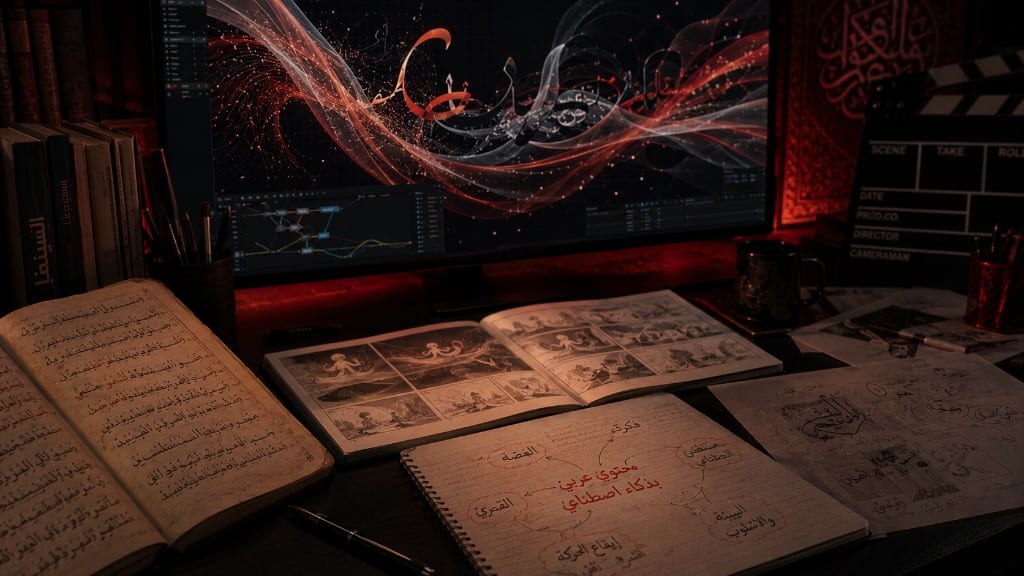
Arabic content creation is being reshaped by two forces at once: the rise of AI production tools and the long-overdue rejection of localization as the default model. For years, too much regional work started somewhere else and arrived in Arabic as a final step. AI makes that workflow faster, but speed alone does not make it better.
The real opportunity is not to translate more efficiently. It is to build Arabic-first pipelines where language, culture, humor, pacing, and visual metaphor are present from the first decision.
The translation layer is showing its age
When content is conceived in English and adapted into Arabic, the production inherits assumptions that may not fit the market. A line may be accurate but emotionally flat. A visual joke may be clear but socially distant. A campaign rhythm may match a global case study and still feel wrong for a Saudi, Emirati, Egyptian, or Levantine audience.
AI can generate copy, frames, and edits quickly, but it cannot decide cultural truth on its own. That makes the human writing room more important, not less.
Software speed needs cultural direction
Animation now moves closer to software speed. Characters can be explored faster. Storyboards can become animatics earlier. Campaign variants can be produced without rebuilding the whole system. But the faster the pipeline moves, the easier it is for work to become generic if no one is holding the cultural line.
For MENA brands, the winning model is a hybrid: native Arabic strategy, AI-assisted production, and senior creative direction judging every output against the audience it is meant to serve.