
2023-06-05
The Brief Is the Product: How We Write Creative Briefs That Actually Ship
A one-page brief with the right constraints will beat a beautiful strategy deck that nobody can turn into decisions on deadline.
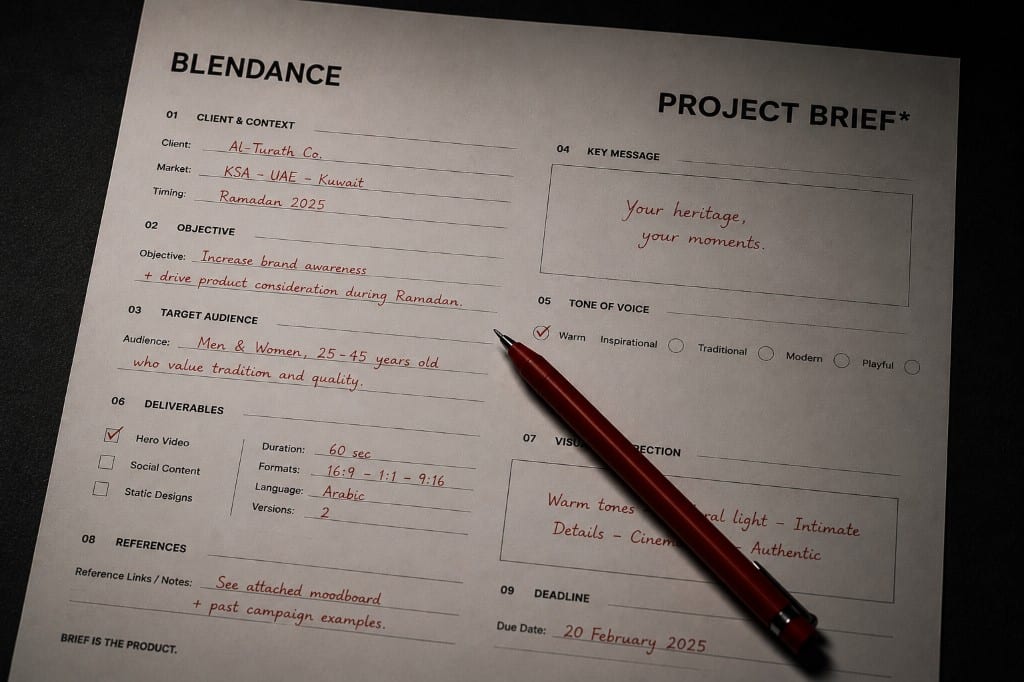
Most briefs fail in one of two ways. They are either strategy decks pretending to be briefs, or WhatsApp messages pretending to be direction. One is too heavy to use. The other is too thin to protect the work.
We treat the brief as the first production asset. If it cannot guide decisions under pressure, it is not done. A good brief does not answer every question. It tells the team which questions matter and which distractions to ignore.
The five fields
Our working brief fits on one page. It has five fields: Audience, Emotional job-to-be-done, Minimum lovable scope, One thing it must never be, and Proof-of-success metric. Each field exists because it prevents a real production failure we have seen more than once.
The most important field is minimum lovable scope. Minimum viable is too cold for creative work. It asks what can technically ship. Minimum lovable asks what must be present for the work to feel alive, intentional, and worth showing. It is the constraint that protects the schedule without turning the output into filler.
- Audience: who must recognize themselves in the work.
- Emotional job-to-be-done: what the audience should feel ready to do after seeing it.
- Minimum lovable scope: the smallest version that still carries the idea.
- One thing it must never be: the fastest way to prevent generic work.
- Proof-of-success metric: the signal that tells us whether the work shipped well.
A practical example
For a retail launch, the brief might define the audience as young parents buying in short mobile sessions. The emotional job is reassurance: "This brand has already solved the chaos I am about to face." The minimum lovable scope is one hero film, six modular social cuts, and a motion template the client team can reuse for weekly offers. The thing it must never be is another discount-first retail ad. The proof metric is not only views; it is saved posts, offer click-through, and reduced revision time on the next content batch.
That is a brief a team can ship from. It gives creative enough freedom to make something specific and production enough constraint to protect the timeline.