
2023-10-18
We Tested Every AI Image Tool for Six Months. Here's What We Actually Use.
A pragmatic studio breakdown of where Midjourney, Firefly, DALL-E 3, and Stable Diffusion actually fit in client production.
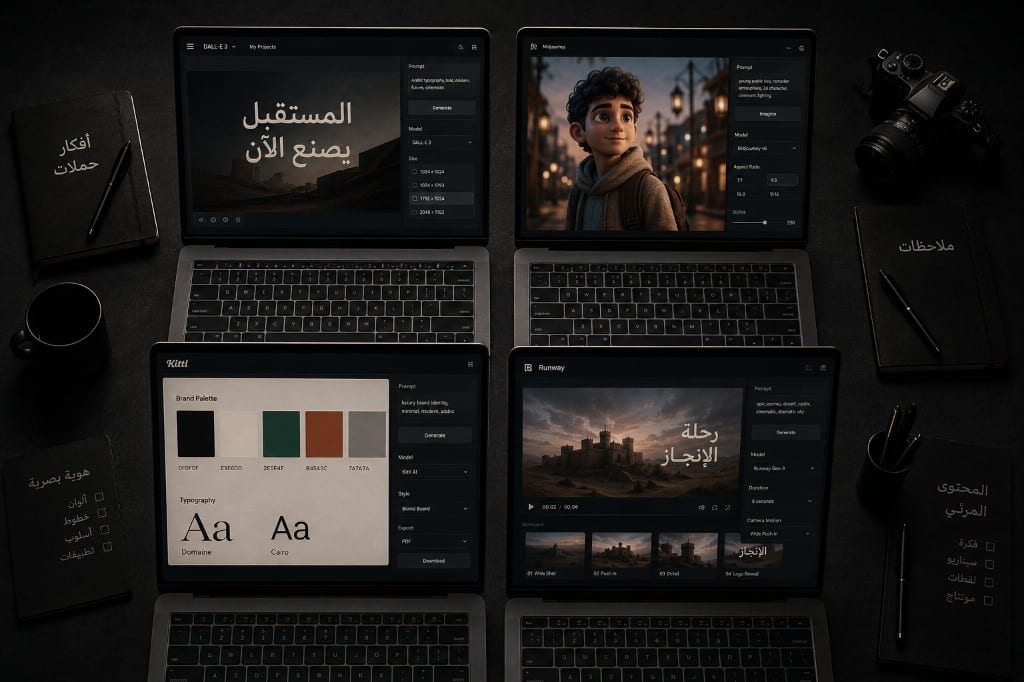
For six months, we tested AI image tools the way a production studio has to test them: not by asking which tool makes the prettiest single image, but by asking which tool survives a client workflow. We pushed Midjourney, Firefly, DALL-E 3, and Stable Diffusion through concept art, storyboard frames, campaign key visuals, character exploration, and brand look development.
The early lesson was simple: AI is excellent at suggestion and uneven at obligation. It can open directions fast, but client work requires repeatability, brand control, and the ability to explain why a decision belongs.
What failed first
Consistent characters were the first wall. A single beautiful frame is not a character system. Eye shape, face proportions, clothing details, and silhouette drifted across variations. Brand color was the second wall. Tools could approximate a palette but struggled to obey it under different lighting and texture prompts. Arabic text was the third wall. It looked like writing until somebody who reads Arabic looked at it.
Those failures mattered because they marked the line between brainstorm accelerator and production tool. Brainstorming can tolerate weirdness. Production cannot hide behind it.
The stack that survived
Midjourney stayed for speed, mood, and broad visual exploration. Firefly earned a place where brand safety and commercial design language mattered. DALL-E 3 became useful for prompt comprehension, especially when we needed a clean literal interpretation. Stable Diffusion stayed because control matters: custom models, references, LoRAs, and pipeline ownership are still the difference between a nice test and a repeatable production layer.
The real shift was not choosing one winner. It was assigning each tool a job and refusing to let any one tool pretend to be the whole studio.