
2024-01-09
Why We Stopped Pitching "Concepts" and Started Delivering Pilots
AI compressed the distance between idea and proof, so we changed the client conversation from presentation approval to pilot judgment.
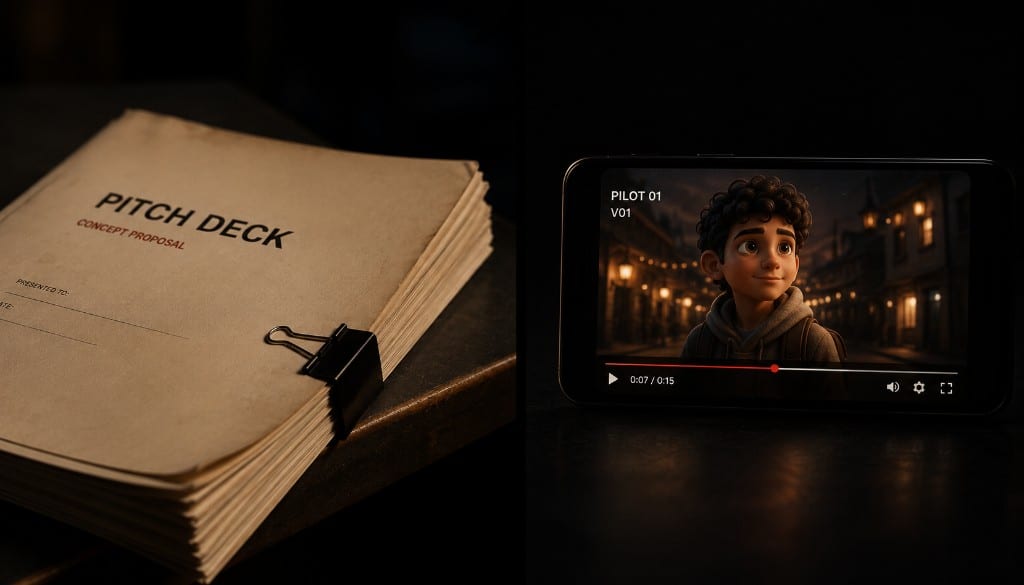
The old agency rhythm was built around deferred proof. Three weeks of pitch work, a concept presentation, client feedback, another round of refinement, and then production finally began. Everyone in the room had to imagine the same finished thing from references, mood boards, and confident language.
AI changed that distance. We can now move from idea to rough motion, character test, script sample, visual language, and edit rhythm in days. That does not make strategy less important. It makes vague strategy harder to hide.
A pilot changes the room
When a client sees a shippable pilot, the conversation becomes concrete. Does the character feel right? Is the pacing too young? Does the Arabic line land? Can this system produce ten more episodes without collapsing? These are better questions than "Do we like the mood?"
A pilot also reveals production truth earlier. If a visual style is too expensive to scale, we learn before the campaign is sold internally. If a character does not hold up in motion, we fix the foundation instead of polishing a deck.
Trust is earned in working form
Agencies still relying on 40-page pitch decks are often borrowing trust from references they did not make. A pilot returns trust to the work itself. It says: here is the voice, here is the timing, here is the visual system, here is what will improve with a greenlight.
For clients, the benefit is not just speed. It is alignment. Less interpretation. Fewer abstract debates. Earlier risk. Better decisions.