
2024-11-12
The Production Stack We Actually Run: Tools, Roles, and What Glues It Together
An inside look at the AI-native production stack from brief to delivery, and where human creative direction still owns the line.
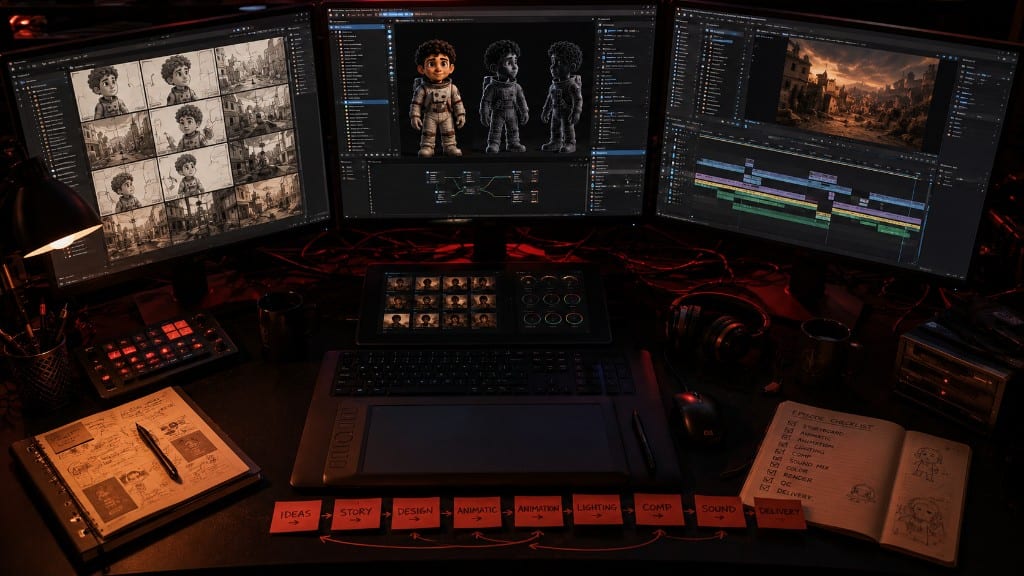
An AI-native production stack is not a list of subscriptions. It is a chain of decisions. Each tool has a job, each human has an ownership point, and the handoff between them determines whether the work scales or turns into a folder full of promising tests.
Our flow starts with the brief. Claude helps pressure-test structure, audience assumptions, and script options. Midjourney accelerates visual exploration. Stable Diffusion and ComfyUI carry the heavier character and consistency work when custom control matters. Runway, Kling, and Pika help test motion routes. ElevenLabs supports voice prototyping. DaVinci Resolve remains the finishing room where rhythm, sound, color, and delivery discipline come together.
The production map
The simplified flow is: brief analysis, creative direction, concept frames, character system, motion tests, voice prototype, edit assembly, finishing, delivery, and format expansion. AI creates more options at each stage, but options are not direction.
The creative director's role changes, but it does not shrink. In a traditional pipeline, direction often means choosing between a few expensive routes. In an AI pipeline, direction means holding the line across hundreds of cheap possibilities. The danger is not scarcity. It is drift.
- Humans own intent, taste, cultural judgment, and the final yes.
- AI owns throughput, variation, exploration, and repetitive production pressure.
- The pipeline only works when every tool output is judged against the same creative rules.
What glues it together
The glue is not automation alone. It is documented direction: character bibles, motion rules, prompt libraries, edit references, naming systems, approval checkpoints, and a shared understanding of what the work must never become.
That is why AI-native studios should make traditional production teams uncomfortable and forward-thinking commissioners excited. The speed is real, but the advantage belongs to the teams that can keep quality coherent while moving that fast.